
You May Also Like to Read


B.E. F.A.S.T.: Your Guide to Ending Stroke
Stroke is a medical emergency that can happen to anyone, anywhere—at home, at work, or while out in your community. Recognizing the signs and acting immediately is the difference between recovery and lifelong disability.
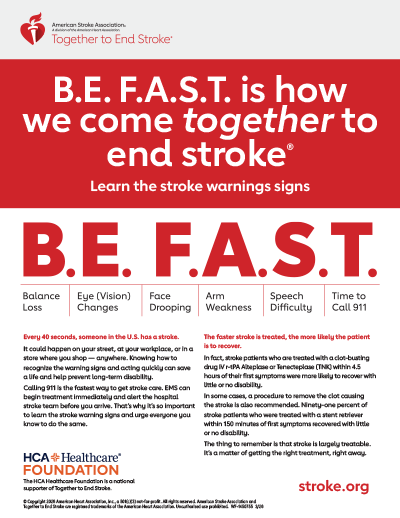
Learn the Warning Signs: B.E. F.A.S.T.
B – Balance: Sudden loss of balance or coordination.
E – Eyes: Sudden vision changes or trouble seeing in one or both eyes.
F – Face: Does one side of the face droop or feel numb? Ask the person to smile.
A – Arm: Is one arm weak or numb? Ask the person to raise both arms. Does one drift downward?
S – Speech: Is speech slurred or strange? Can they repeat a simple sentence?
T – Time: If you see any of these signs, call 911 immediately.
Stroke in Texas: The Reality
Stroke remains a critical health challenge for Texans. Understanding the local impact highlights why rapid response is so vital:
| Statistic | Impact in Texas |
| State Ranking | Texas ranks 32nd in the nation for stroke prevalence (2026 AHA/Texas Council report). |
| Prevalence | Approximately 3.3% of Texas adults have a history of stroke. |
| Leading Cause | Stroke is the 4th leading cause of death in Texas. |
| Economic Burden | Hospital charges for stroke in Texas exceeded $9.6 billion in a single year (2023). |
| High-Risk Areas | Prevalence is highest in North and North-East Texas (Dallas County at 4.4%). |
Note: Only 1 in 3 stroke patients in Texas currently arrive at the hospital within the critical treatment window, and less than half utilize EMS services, which are essential for better outcomes.
Why Every Second Counts
The faster a stroke is treated, the more brain tissue can be saved.
EMS is the Fast Track: Calling 911 is the most effective way to start care. EMS can begin treatment on the way and alert the hospital stroke team before you even arrive.
Clot-Busting Treatments: Patients treated with “clot-busting” medications (like IV r-tPA or TNK) within 4.5 hours of symptom onset are significantly more likely to recover with little to no disability.
Advanced Procedures: In severe cases, a stent retriever can be used to manually remove a clot. 91% of patients who receive this procedure within 150 minutes of symptoms achieve a successful recovery.
Stroke is largely treatable, but treatment depends on you. Learn the signs, share them with your loved ones, and if you suspect a stroke, B.E. F.A.S.T. and call 911.
References:
American Heart Association (2026). Heart Disease and Stroke Statistics Update.
Texas Council on Cardiovascular Disease and Stroke State Plan (2024-2026).
Click the graphic below to find more info from the American heart association.

Recent Comments